






Southeast Asian businesses are facing operational and financial losses of up to US$1 million due to unmanaged and unsecured endpoint devices, according to new research from Tanium.
The State of Endpoint Management in ASEAN 2026 report, which surveyed 333 senior IT and security professionals across five markets, reveals widespread gaps in visibility, patching, and compliance that are exposing organisations to significant risk.
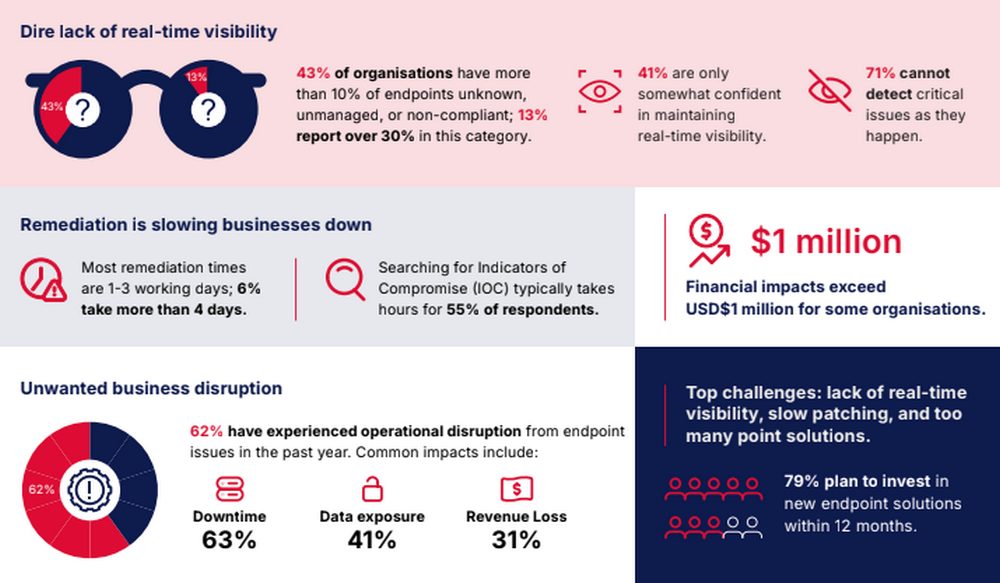
Operational disruption and financial impact
The study found that 62% of organisations across the region have experienced operational disruption from endpoint issues, resulting in downtime (63%), data exposure (41%), and revenue loss (31%). Financial losses from endpoint incidents exceeded US$1 million for some organisations, with 46% reporting losses above US$100,000 and 17 per cent above US$500,000.
Despite 59% of respondents describing themselves as “very confident” in their ability to track devices, 43% admit that more than 10% of endpoints are unknown, unmanaged, or non-compliant. A further 13% report that over 30% of their endpoints fall into this category.
Visibility and response gaps
Only 29% of organisations can detect critical issues within minutes, while 55% take hours to identify a single threat indicator. In sectors such as healthcare and telecommunications, where legacy devices and critical infrastructure are increasingly connected to enterprise networks, these blind spots carry severe operational and safety implications.
Patching remains a critical vulnerability. Just 16% of organisations can address critical vulnerabilities across the majority of their systems within 24 hours, with 60% still relying on partially automated processes.
In financial services, where legacy core banking systems often require planned downtime for updates, delayed patches create extended windows of exposure.
Compliance pressures mount
The compliance burden is also intensifying. Half of ASEAN organisations face quarterly IT asset audits, yet only 50% can prepare audit-ready data in under a week, with 46% needing between one and four weeks.
As Singapore’s Cyber Security Act tightens expectations, public sector agencies and critical infrastructure operators relying on manual audit preparation are falling behind regulatory requirements.
“Geopolitical conflict has gone digital, while AI is accelerating both innovation and attacks. The devices connecting it all are increasingly outside the visibility of the teams responsible for protecting them,” said Satyen Desai, RVP, ASEAN, Tanium.
“This research reaffirms what we hear from customers across the region. The misconception between confidence and actual control is real, it is widening, and it is expensive.” Satyen Desai
Investment shifts underway
Seventy-nine per cent of respondents plan to invest in new security solutions within 12 months, signalling that endpoint management has become a board-level priority.
However, the top frustrations cited—poor visibility, slow response times, and too many disconnected tools—point to fragmentation rather than insufficient spend.
Organisations that consolidate onto unified, real-time platforms and automate response cycles are already seeing measurable improvements in risk posture and operational resilience.