






For many business leaders, AI ethics and governance are often viewed as a necessary burden—a cost of doing business to avoid regulatory fines and reputational damage.
However, new research from the IBM Institute for Business Value (IBM IBV) suggests this perspective is outdated and costly. Investing in AI ethics is not just about risk mitigation; it is strongly associated with business growth and superior financial performance.
The IBM IBV study, "The AI ethics trust engine," conducted with the Notre Dame-IBM Technology Ethics Lab, surveyed 915 executives across 19 countries and 18 industries.
The findings are compelling: organisations that invest more in AI ethics consistently achieve higher operating profit, stronger return on investment, and measurable competitive advantage from their AI initiatives.
Specifically, organisations spending more than 10% of their AI budgets on ethics saw 30% higher operating profit from AI than those spending 5% or less—a performance gap that persisted for two years. IBM researchers caution that this correlation reflects broader AI capability maturity rather than a simple causal formula; ethics investment tends to signal deeper strategic, talent, and infrastructure readiness.
The link between ethics and profit is trust. Executives report that the top benefits of AI ethics investments are increased trust (61%), strengthened brand reputations (57%), and mitigated reputational risks (54%).

In a market where consumers and partners are increasingly wary of AI, trust is a currency. "If your employees, your customers, your suppliers don't trust your AI, they won't adopt it," Brian Goehring, associate partner and AI research lead for IBM's IBV, told IBM Think.
Building that trust pays off: companies investing in AI ethics reported 22% improvement in customer satisfaction and retention, 20% better incident prevention and 19% higher AI adoption rates. A majority (59%) of executives say their ethics efforts delivered results.
The governance gap: What the data reveals
Despite the clear business case, many organisations are still lagging in execution, noted the IBV study. Only about one-third of executives globally say their organisations are applying a set of core AI ethics-specific tools today, even though 56% cited trust, bias or explainability as barriers to AI adoption and 62% reported tension between business goals and ethical values.
This governance-execution gap is a global phenomenon. According to EY Responsible Pulse research, 51% of companies agree that it is "challenging" to develop governance for current AI technologies, while the "outlook" for emerging AI technologies is "even more concerning".
More specifically, only 58% of executives polled could say they were "moderately or extremely familiar" with the risk associated with synthetic data generation, despite 88% saying they are currently using the tech or plan to do so.
Similarly, only 51% could say they were comfortable with the risk involved in "self-improving AI models", while 72% were using AI currently or will do so soon.
Perhaps most tellingly, there is a significant misalignment between executives and consumers on AI risk perception. When it comes to accountability for "negative" AI use, only 23% of executives see it as a concern, while a much larger proportion—58% of consumers—view it as a problem. Likewise, 32% of C-suite leaders fret about security breaches in AI systems, while 61% of consumers are concerned. This trust gap directly threatens the adoption and ROI of AI initiatives.
Cathy Cobey, EY's global responsible AI leader for assurance, emphasises that AI governance is not a one-time exercise: "It's not a 'one-and-done' exercise but a journey where your AI governance and controls need to keep pace with investments in AI functionality."

"Maintaining trust and confidence in AI will require continuous education of consumers and senior leadership, including the board, on the risks associated with AI technologies and how the organisation has responded with effective governance and controls." Cathy Cobey
Gartner's evidence: Governance drives value
Gartner research reinforces the business case for governance. A survey conducted May-June 2025 among 360 organisations found that organisations performing regular AI system assessments are over three times more likely to achieve high generative AI value than those that do not.**
Kjell Carlsson, VP analyst at Gartner, explains: "AI governance really is a case of doing well by doing good, but it depends on the specific governance practice. Some just help reduce risk and support legal compliance, while others also boost the value delivered by GenAI initiatives."
Gartner identified five governance practices that directly correlate with higher value:
- Providing persona and role-based guidance: 2x more likely to report higher value
- Providing GenAI ethics training: 1.7x more likely
- Investing in third-party AI governance products: 1.9x more likely
- Conducting regular AI system assessments: 3x more likely
- Safely expanding GenAI rollouts beyond low-risk users: 3.3x more likely
*The Gartner survey included respondents from organisations with 250+ full-time employees across North America, Europe, and Asia/Pacific, excluding IT software companies.
Forrester's view: The trust tax challenge
Forrester's research adds another dimension: the "trust tax" that burdens AI deployments. A recent Forrester report found that while 75% of enterprise leaders have initiated AI agent projects, only a marginal minority have moved them beyond the pilot phase. The primary barriers are not technical—they are governance, security, and trust.
Brian Hopkins, VP and analyst at Forrester, notes that the cost of controls, audit trails, and identity management for autonomous agents often makes narrow, task-level deployments uneconomical, particularly when governance and security requirements are factored in. This arithmetic is the real filter separating experiments from production deployments.
Forrester's research also reveals that while most agree AI boosts productivity, only 13% report positive EBITDA impact, and fewer than a third link AI contributions to P&L. Without financial accountability, AI becomes an endless pilot treadmill—producing activity without outcomes. Additionally, 40% of decision-makers cite security and risk as their top concern, yet the pressure to go fast often trumps safeguards.
Three questions for CISOs to drive AI ethics value
Based on the research findings, here are three critical questions Southeast Asian CISOs should ask their teams:
Question 1: How much of our AI budget is allocated to ethics and governance—and what return are we seeing?
The IBM IBV research shows that organisations spending more than 10% of AI budgets on ethics achieve 30% higher operating profit from AI. Yet only one-third of organisations use core AI ethics tools. If you cannot answer this question, you are likely leaving significant value on the table. Start by mapping your AI ethics spend and measuring its impact on trust, customer satisfaction, and AI adoption rates.
Question 2: Do we conduct regular AI system assessments and audits?
Gartner found that organisations performing regular assessments are three times more likely to achieve high value from generative AI. If your organisation is not conducting formal, AI-specific risk assessments for models and vendors, you are operating with a blind spot. Implement a regular assessment schedule and deploy AI governance platforms to streamline auditing.
Question 3: How do our AI governance practices compare to consumer trust expectations?
EY research reveals a significant gap between executive and consumer perceptions of AI risk. For example, while only 23% of executives worry about accountability for negative AI use, 58% of consumers do.
Similarly, 32% of executives fret about security breaches, while 61% of consumers are concerned. If your governance framework does not account for these perception gaps, you are building trust deficits that will undermine AI adoption and brand reputation.
EY's Cobey advises continuous education of both leadership and consumers on AI risks and controls.
Thoughts to drive your AI strategy in the future
This is especially true for the autonomous and complex realm of agentic AI. As AI agents gain more autonomy, the urgency to address these challenges strategically only amplifies.
Perhaps a sign of things to come, the Financial Stability Board issued its Sound Practices for Responsible Adoption of Artificial Intelligence (AI): Consultation report on 10 June 2026, seeking stakeholder input before finalising guidance later this year. The report notes that rapid transformation of operations and services among financial institutions through AI "amplifies or introduces risks that need to be identified and managed appropriately."
In Asia, the governance gap is even more pronounced. An IDC survey found that Southeast Asian organisations are accelerating AI adoption—42% have already implemented agentic AI, with nearly 44% planning to do so within 12 months. Yet AI governance and risk management (22%) remains the top challenge hindering AI growth in the region.
The organisations that will win with AI in Asia will not be the ones that move the fastest, but those that move with the most integrity. As the IBM IBV report concludes, organisations "embedding trust can capture more business value from their AI investments—including direct financial benefits, a positive brand and culture, and new capabilities that deliver long-term advantages."
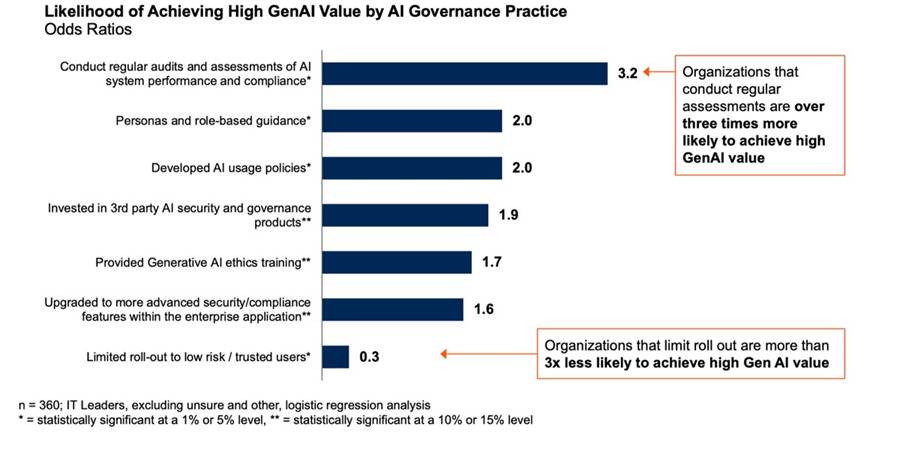

Kjell Carlsson, VP analyst at Gartner, explains: "AI governance really is a case of doing well by doing good, but it depends on the specific governance practice. Some just help reduce risk and support legal compliance, while others also boost the value delivered by GenAI initiatives."
Gartner identified five governance practices that directly correlate with higher value:
- Providing persona and role-based guidance: 2x more likely to report higher value
- Providing GenAI ethics training: 1.7x more likely
- Investing in third-party AI governance products: 1.9x more likely
- Conducting regular AI system assessments: 3x more likely
- Safely expanding GenAI rollouts beyond low-risk users: 3.3x more likely
*The Gartner survey included respondents from organisations with 250+ full-time employees across North America, Europe, and Asia/Pacific, excluding IT software companies.
Forrester's view: The trust tax challenge
Forrester's research adds another dimension: the "trust tax" that burdens AI deployments. A recent Forrester report found that while 75% of enterprise leaders have initiated AI agent projects, only a marginal minority have moved them beyond pilot phase. The primary barriers are not technical—they are governance, security, and trust.

Brian Hopkins, VP and analyst at Forrester, notes that the cost of controls, audit trails, and identity management for autonomous agents creates a situation that often makes narrow task-level deployments uneconomical, particularly when governance and security requirements are factored in. This arithmetic is the real filter separating experiments from production deployments.
Forrester's research also reveals that while most agree AI boosts productivity, only 13% report positive EBITDA impact, and fewer than a third link AI contributions to P&L. Without financial accountability, AI becomes an endless pilot treadmill—producing activity without outcomes. Additionally, 40% of decision-makers cite security and risk as their top concern, yet the pressure to go fast often trumps safeguards.
Three questions for CISOs to drive AI ethics value
Based on the research findings, here are three critical questions Southeast Asian CISOs should ask their teams:
Question 1: How much of our AI budget is allocated to ethics and governance—and what return are we seeing?
The IBM IBV research shows that organisations spending more than 10% of AI budgets on ethics achieve 30% higher operating profit from AI. Yet only one-third of organisations use core AI ethics tools. If you cannot answer this question, you are likely leaving significant value on the table. Start by mapping your AI ethics spend and measuring its impact on trust, customer satisfaction, and AI adoption rates.
Question 2: Do we conduct regular AI system assessments and audits?
Gartner found that organisations performing regular assessments are three times more likely to achieve high value from generative AI. If your organisation is not conducting formal, AI-specific risk assessments for models and vendors, you are operating with a blind spot. Implement a regular assessment schedule and deploy AI governance platforms to streamline auditing.
Question 3: How do our AI governance practices compare to consumer trust expectations?
EY research reveals a significant gap between executive and consumer perceptions of AI risk. For example, while only 23% of executives worry about accountability for negative AI use, 58% of consumers do.
Similarly, 32% of executives fret about security breaches, while 61% of consumers are concerned. If your governance framework does not account for these perception gaps, you are building trust deficits that will undermine AI adoption and brand reputation.
EY’s Cobey advises continuous education of both leadership and consumers on AI risks and controls.
Thoughts to drive your AI strategy going forward
This is especially true for the autonomous and complex realm of agentic AI. As AI agents gain more autonomy, the urgency to address these challenges strategically only amplifies.
Perhaps a sign of things to come, the Financial Stability Board issued on 10 June 2026, its Sound Practices for Responsible Adoption of Artificial Intelligence (AI): Consultation report, seeking stakeholder input before finalizing guidance later this year.
The report notes that rapid transformation of operations and services among financial institutions through AI "amplify or introduce risks that need to be identified and managed appropriately."
In Asia, the governance gap is even more pronounced. An IDC survey found that Southeast Asian organisations are accelerating AI adoption—42% have already implemented agentic AI, with nearly 44% planning to do so within 12 months. Yet AI governance and risk management (22%) remains the top challenge hindering AI growth in the region.
The organisations that will win with AI in Asia will not be the ones that move the fastest, but those that move with the most integrity. As the IBM IBV report concludes, organisations "embedding trust can capture more business value from their AI investments—including direct financial benefits, a positive brand and culture, and new capabilities that deliver long-term advantages."