




Cybersecurity budgets are set to absorb a sharp rise in spending on tools specifically designed to secure artificial intelligence, with Gartner forecasting the “securing AI” market will reach almost US$4.8 billion in 2027, up 68.7% from 2026.
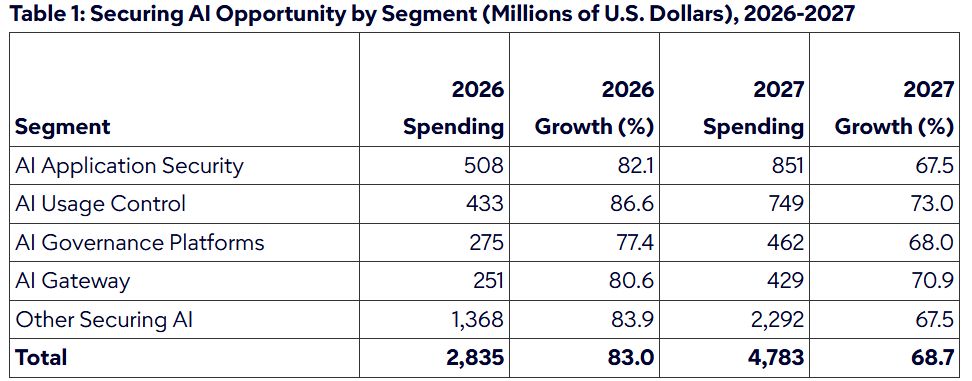
By 2028, the market is expected to approach US$7.7 billion as security leaders move to protect AI models, applications and usage from novel attack vectors that traditional controls were never built to handle.
“This surge is driven by the urgent need for enterprises to secure AI systems, address emerging vulnerabilities and strengthen defences against sophisticated cyberthreats,” said Shailendra Upadhyay, senior principal analyst at Gartner.
He warned that the threat landscape is being compounded by growing vulnerabilities and supply-chain attacks involving third-party and open-source software in AI projects. “Without adequate security and visibility controls, enterprise AI initiatives face a high risk of failure.”
Gartner predicts that, by 2029, more than half of successful cyberattacks on AI agents will exploit access control weaknesses and prompt injections, forcing security teams to adopt specialised monitoring and protection for AI workloads.
“Traditional security tools often treat AI applications like any other software and need significant updates to address AI-specific threats,” Upadhyay said. “Specialized solutions, such as AI usage control and application security, will see rapid growth as solutions that address these challenges.”
The securing AI market is split into four cybersecurity-focused categories: AI application security, AI usage control, AI governance platforms and AI gateways. AI application security will remain the largest spending category in 2027 at almost US$851 million, followed by AI usage control at US$749 million.
However, AI usage control is forecast to grow fastest, at 73%, with AI gateways close behind at 70.9%, reflecting demand for runtime protection, policy enforcement and traffic inspection tailored to AI systems.
“As defences like AI runtime protection and dedicated gateways become more reliable, organisations will gain confidence in these tools, accelerating adoption,” Upadhyay said.
He noted that as businesses expand their AI initiatives, the need for specialised AI security solutions will intensify, “especially as autonomous AI introduces new vulnerabilities beyond the reach of traditional monitoring.”
Competition in the market varies by segment. For AI governance platforms and AI gateways, which often extend existing enterprise systems for governance, data and API management, established vendors are likely to maintain their lead by adding AI features or integrating niche products.
In contrast, the AI application security and AI usage control segments are attracting a wave of startups. “As the market grows, we can expect increased consolidation and acquisitions, with larger cybersecurity companies buying these startups to broaden their offerings,” Upadhyay said.