




Even as Singapore strengthens its national digital identity with device-bound passkeys to secure the login, the live video session remains a gaping exposure layer. Once authenticated, high-value activities—remote approvals, KYC reviews, and workforce verification—are conducted over mainstream video platforms that rely on trust and manual checks.
This is dangerously insufficient as deepfake video injection attacks become more capable and affordable. The question for CISOs is no longer "who logs in," but "who is actually present in the frame."
Yet as Dominic Forrest, chief technology officer at iProov, explains, securing the login is only half the battle. Once a user is inside a live video session, the organisation is largely on its own — relying on trust, familiarity and manual checks that deepfakes and injection attacks are rendering obsolete.
The question for CISOs across Southeast Asia and Hong Kong is no longer just who logs in, but who is present in the frame.
A region with strong digital economies, but lagging trust controls
Forrest opens with a candid assessment of the region's posture. "If I look at the region, Singapore and Southeast Asia more generically and Hong Kong have built very strong digital economies but as always, trust controls have not always kept up to date and expanded at the same pace as the journeys the remote work we all now do as well as the real-time payments we see every day."
Stolen credentials, often harvested through phishing, remain a persistent problem. Singpass' introduction of passkeys — which Forrest notes is "in iOS only and beta at the moment" — is a significant step forward because they "tie that device to the website and are phishing resistant" and represent "credentials that cannot be shared."
But as defences at the login layer improve, attackers move to the next weak point. "As that happens, the criminals, of course, move on and look for the next weak target. And what they're doing is starting to impersonate the user," Forrest says.
The scenario he describes is already familiar to many security teams: "If I cannot take over the person's credentials, then let me get a credential reset done for them. Call the help desk, jump on a Teams call, get on a video call, and deepfake myself so I appear to the help desk as the genuine person, not just with my face, but with my voice as well."
This, Forrest argues, reframes the problem as one of continuous risk management rather than point-in-time authentication. "The credentials are issued. You've got very strong passkeys for your corporate security for access to an application. But you need to know who is using those at a moment in time. Also, when they're being remotely set, to be very sure you're giving those credentials back to the correct person."
Why passkeys cannot secure the session
To understand the gap, Forrest walks through the technology. "At its simplest, passkeys are a pair of cryptographic signatures, a cryptographic key tied together. So, one on the server, one on the end user's device. They can authenticate each other." The result is mutual trust: "the client knows it's the server, the server knows it's the client."
That mutual authentication is highly effective against phishing. "If the user is redirected to a phishing website, the phishing website will not have the cryptographic information it needs to be able to authenticate the user." But it says nothing about who is holding the device after login.
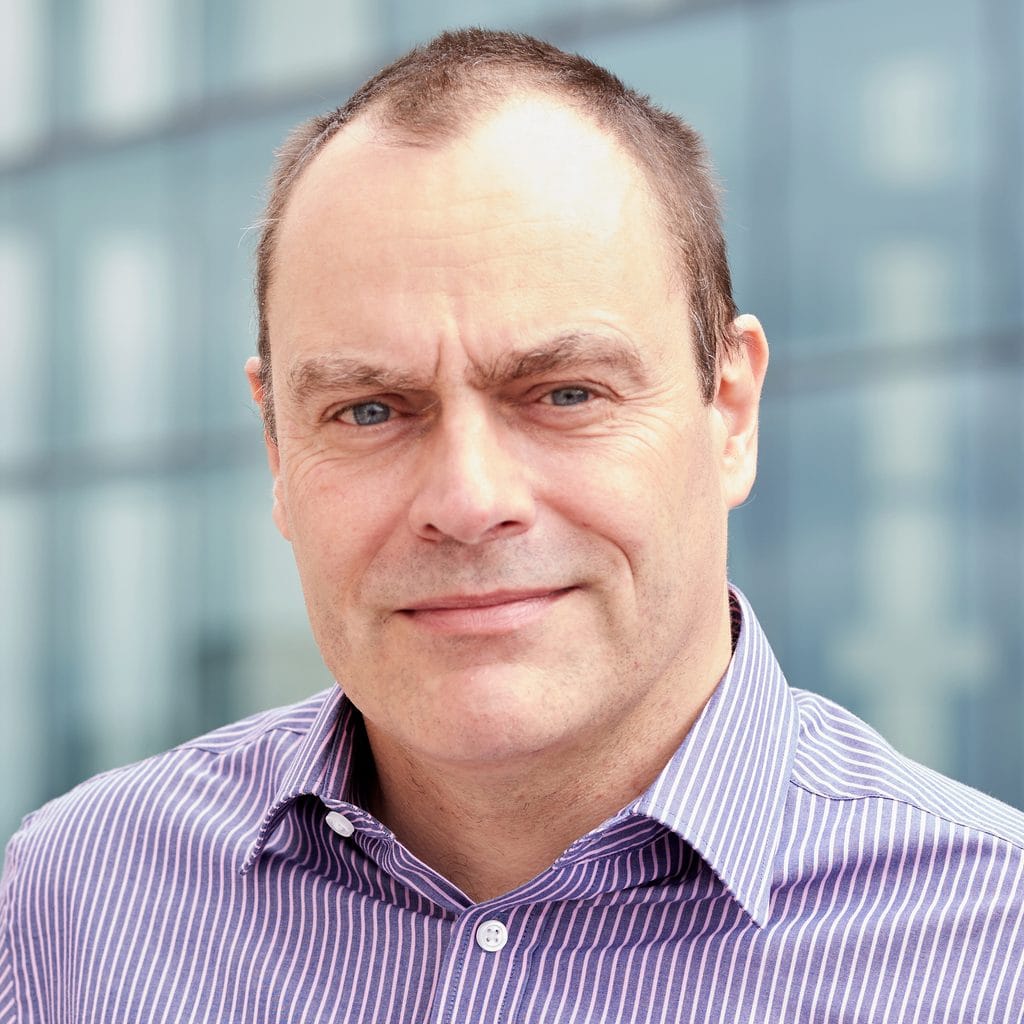
"The challenge you've got is once the user is logged on, so they've authenticated, and that may be a very long-lived session; maybe they then do, as you say, start a Teams call. Do you know he or she is still that right user on that Teams call? It is, of course, the right device. You've just proven that with a passkey. But who has access to that device? Who has got access to that passkey?" Dominic Forrester
Forrest is blunt about what security leaders need to know. "If I look at our corporate security, I'm not interested in knowing that one of my users' devices is accessing one of our systems. I want to know who is accessing one of our systems. And that's exactly where deepfake attacks come in. People are making use of deepfakes and very specifically face swaps to take over accounts of genuine users. And that is a growing problem."
The collapse of manual video verification
Since COVID, remote work has become the norm, and with it, remote workforce verification and high-value approvals conducted over video. These processes, Forrest explains, often rely on little more than human judgment. "If we look at manual video checks, so this is somebody getting on the call with perhaps a service desk or somebody they know within the organisation. It relies a lot on familiarity. Do I recognise this person? Does this feel right? Is there anything here that concerns me? And this is exactly what deepfakes can exploit."
What has changed is the technology's accessibility. Forrest recalls the first time he encountered a deepfake he could not distinguish from a real face, in December 2020. "I've spent the last 13 years of my life looking at faces. And if I can't tell the difference, I feel that most people would not be able to."
Back then, creating such a fake required "people with PhDs in computer vision and vast amounts of compute resources." Today, the barrier is gone. "You can download free software. In fact, we used more than 130 tools to carry out a small type of deepfake attack, which is called face swapping, and got it up and running in real time on your average Windows gaming PC."
The implications are stark.
"An unskilled user from start to finish can download, install, take a single image of yourself, of myself, from our websites, from LinkedIn, from wherever it may be, and appear as them, appear as you, appear as me on a video call. It takes no skill, and it takes very moderate computing power." Dominic Forrest
Real-world losses and the scale of the threat
Forrest cites two incidents as warnings. The first involved the engineering firm, Arup. "After an incident in Hong Kong, it transferred US$20 million to an attacker." He praises the company for going public so others could learn.
The second involved a Singapore organisation. "The CFO did exactly this. He went on a call with people he thought he knew, and at the end of the call he transferred money. That was not the real people on the call. That was the attackers."
The money was eventually clawed back, but only because the attackers returned, asked for a second transfer, and raised suspicion.
These are not isolated cases. Forrest points to broader trends: "In the United States, the FBI have warned organisations about the attacks on their identity systems and employees from North Korea. And this is using deepfakes at the video interview time." The same technology is also being used for account takeover.
Injection attacks: When the camera cannot be trusted
Forrest then explains a less understood but equally dangerous vector: injection attacks. "If I've got some video which I've manipulated — so I've deep faked it, I've perhaps swapped my face to somebody else — I've then got to make use of that video," he says. "Getting the imagery into the video stream is called an injection attack. You're injecting that imagery into the software in such a way that it appears to the software that it is talking to its local camera."
The root cause is architectural. "None of this software was designed to attack that. The idea of having real-time manipulation of imagery where I could appear as somebody else just did not exist as a concept a few years ago," said Forrest.
Modern operating systems, he notes, have secure enclaves and strong encryption, "but the camera is treated differently. To all intents and purposes, even if it is built into a laptop, it is effectively sitting on the end of a USB connection. And the operating system trusts it blindly. It does not authenticate it. It does not know it's a real camera. And that opens the door for the attackers to inject manipulated imagery into the stream."
The high-risk moments in financial services
Forrest identifies the points in the customer lifecycle where presence assurance matters most. Account opening is one. "You need to know the person who is opening the account is absolutely the right person and you're not creating an account which can then be used for money laundering for a criminal."
Doing this in person is not a reliable answer. "We as human beings are very, very bad at matching faces," he says, noting that studies show trained border officers let the wrong people through 15% of the time.
Account takeover is the other major target. Forrest describes the device-rebinding process that occurs when a customer loses or replaces a phone. "This happens not tens, not hundreds, but thousands and thousands of times a day for the banks. So, this onboarding is a very weak part and has to happen at scale and has to happen remotely."
The Monetary Authority of Singapore (MAS) highlighted this risk and required non-shareable credentials for the process. But with deepfakes and generative AI, Forrest warns, "that account takeover process can be completely automated at scale."
He outlines how attackers could operationalise this: "I can use one of the LLMs to go and search for people. We find bank account details online all the time... I know your name. I have your bank account details. I can go and find you completely automatically on LinkedIn and then walk through completely automatically at scale that account reset process."
Even a success rate of one in a thousand becomes profitable at millions of attempts per day.
Moving beyond blink tests: Real person, right person, right now
Traditional liveness checks — blink, smile, turn your head — no longer work. "The criminals can not only do it and follow those instructions about blinking three times and moving your head and smiling every time correctly because they do it a lot, but they can fully automate it as well using AI and face swaps. So they can pass these tests 100% of the time." Worse, these tests disadvantage genuine users.
"Perhaps some of the less technically literate people, maybe elderly people, maybe people with disabilities, will find that far harder to do. What you've done, if you try to use that sort of technique, is create something easier for the criminals to bypass than it is for the genuine users to use."
Forrest outlines three requirements for strong liveness. "Is it a real person?... Is it the right person?... And lastly, you need to know that the person is in front of the camera right now." He summarises this as "real person, right person, right now."
iProov's approach, he explains, involves taking control of the screen and flashing a short, unique colour sequence on the user's face, then analysing the reflected light. "That colour sequence is different every single time the user makes use of it. So, if an attacker has compromised the handset or the network and captures that video session, it cannot be reused later."
Singpass, he notes, "has been using liveness as part of its national identity scheme since 2020. And that is a very, very strong liveness."
Layering defences: Passkeys plus presence
Forrest is clear that passkeys and presence assurance are complementary, not competing. "Most security systems are stronger if you have multiple layers of defence. Passkeys are a great layer, and they have their part to play. What they are doing is proving that the device being used is the known device and the device of the end user."
Presence assurance answers the next question. "Is it the right person who has that device in their hand at that moment in time?"
In a video call context, this matters throughout the session, not just at the start. "You want to know, or may need to know, for high-risk calls that it's actually the same person on that call throughout. We've all been on video calls where our video has glitched out for a few seconds, and the person rejoins... How do you know that when that person rejoins it's the same person and it's not now someone else in front of the camera?"
Regulation and the CISO roadmap
Singapore's regulator has been proactive. "MAS has absolutely called out deepfakes as a financial sector risk," Forrest says, covering account takeover, account rebinding, onboarding and step-up authentication. "MAS' guidance to banks in Singapore calls for robust documentary, call and video verification. But that call and video verification has to be deepfake-resistant."
Education alone is insufficient. "I've spent 13 years of my life looking at faked faces. I can't tell the difference anymore. If I can't tell the difference, most people cannot tell the difference. So, in much the same way as we do for other things, such as phishing, education is a key point here... but we cannot rely on our staff to be the sole layer."
Forrest offers CISOs two practical tests for evaluating vendors—first, international standards. "The first international standard for this has been created in Europe that actually names CEN/TS 18099, which is being turned into an ISO standard at the moment, though that will probably not be available as an ISO standard until the end of 2027 or even in 2028. So look for those standards; look for the highest levels of certification against those standards."
Second, look at what national governments have tested and adopted. "The people who can test these systems properly, the people who have the resources to test them extensively, are typically national governments. Look at the national governments with the finances and technical capabilities to do that."
The logic is simple: governments protecting critical national infrastructure will have conducted extensive testing. "Look at what their conclusions are and learn from them."
The road ahead
For CISOs in Singapore, Southeast Asia and Hong Kong, the message is clear. Passkeys have closed one door, but the video session remains wide open. Deepfakes are cheap, injection attacks exploit trusting operating systems, and manual verification matches neither.
As organisations push more high-value activity into remote and video-based channels, presence assurance — verifying the real person, the right person, right now — becomes an essential layer alongside device-bound credentials. The technology exists, the standards are emerging, and regulators such as MAS are already pointing the way.
The question is whether CISOs will move fast enough to close the gap before attackers scale it further.
Click on the PodChats player to listen to more details.
- How would you define the current state of identity and session security in Southeast Asia and Hong Kong, given the rapid digital adoption and escalating AI-driven threats?
- Device-bound passkeys effectively secure the login session against phishing. However, once a user is "inside" a live video session, what new exposures emerge that passkeys cannot address?
- With remote workforce verification and high-value approvals now routine over video, what gaps remain in current manual verification processes? Why are these gaps particularly concerning for CISOs?
- How do injection attacks work, and why are they so difficult to detect with traditional verification methods?
- How are attackers evolving their techniques, and what makes these attacks especially dangerous for banks and fintechs?
- Traditional liveness detection—such as blink checks and smile prompts—is failing against modern AI-generated deepfakes. What newer technologies are emerging to verify genuine human presence in real time during live video interactions?
- How can continuous presence assurance at the video layer complement device-bound passkeys and national digital identity schemes to help CISOs build a more layered, resilient defence?
- Finally, how are regulators in the region responding to these threats, and what should CISOs be prioritising on their roadmaps to stay ahead?