




A new QBE Global survey reveals that Singapore, Hong Kong businesses more optimistic about AI than global peers—yet more exposed to supply chain cyber-risks. The findings underscore coverage and response gaps alongside rising cyber threat exposure.
QBE’s inaugural international cyber risks and AI study reports that business and technology leaders in Hong Kong and Singapore are overwhelmingly positive about AI’s potential. Over the next two years, 96% in Hong Kong and 97% in Singapore expect AI to make a positive impact, compared with 92% globally.
The survey also highlights a persistent disconnect between optimism and preparedness. Almost half of businesses in Hong Kong and Singapore have experienced a supply chain cyber-attack, where attackers exploit supplier vulnerabilities and the level of trust companies place in vendors and partners. QBE says this pattern places organisations at risk through relationships they rely on for delivery and operations.
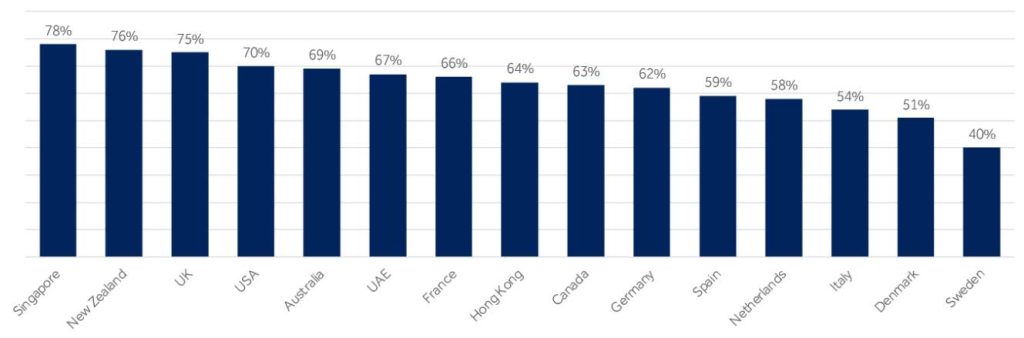
Source: QBE 2026
Insurance coverage and incident readiness also appear uneven. 22% of companies globally, including Hong Kong, do not have cyber insurance, while 18% of Singapore businesses are similarly uninsured across the three markets surveyed. In addition, around 14% of companies across all markets lack a cyber response plan.
Hong Kong: operational priorities, AI safety assessments
In Hong Kong, respondents identified business priorities that align with AI adoption goals. The top reason for using AI was increasing operational awareness (56%), followed by increasing operational agility (43%) and driving revenue growth (26%).
For meeting current cyber risks, QBE reports that conducting impact assessments was the leading measure. However, the proportion of companies that have experienced at least one AI-related cyber event in the past year was 27% in Hong Kong, which is below the global average reported at 29%.
Singapore: productivity focus, higher AI-related event experience
Singapore respondents were more focused on productivity outcomes. Some 54% of survey participants cited increasing productivity through AI, with innovation (40%) and building competitive advantage (40%) also featuring prominently.
On AI safety measures, the survey states that staff training was given precedence by half of respondents. QBE also points to additional measures including ensuring data quality and instilling human oversight. Notably, 39% of Singapore businesses reported experiencing at least one AI-related cyber event in the past year, the highest rate among the markets compared in the study.
Shared concern: suppliers and AI risk exposure
QBE says the supply chain challenge is also visible in supplier-related attack experience. Globally, 38% of businesses reported an attack related to a supplier, rising to 43% in Hong Kong and 42% in Singapore. The survey adds that almost two-thirds of Hong Kong companies and over three-quarters of Singaporean businesses are concerned about risks arising from supplier use of AI.
“Companies can no longer be solely concerned with their own cyber defences. They must now consider the cyber vulnerabilities of their suppliers, as perpetrators exploit weaknesses that arise with such partnerships,” said Sam Russell-Vick, regional cyber lead at QBE Asia. “Our survey confirms that while AI is widely seen as a noteworthy business enabler, it is also a serious threat.”
Coverage and response gaps linger
The study also reports underinsurance in specific sectors, including construction and manufacturing, alongside ongoing exposure to cyber events that disrupt operations. Across the markets, QBE notes that uninsured shares and response-plan gaps remain material even as AI optimism is high.