






APAC banking leaders are sounding the alarm on the next phase of AI-enabled financial crime, reveals a new BioCatch survey which also suggests that “AI agents” may be the industry’s greatest exploitable vulnerability over the coming year.
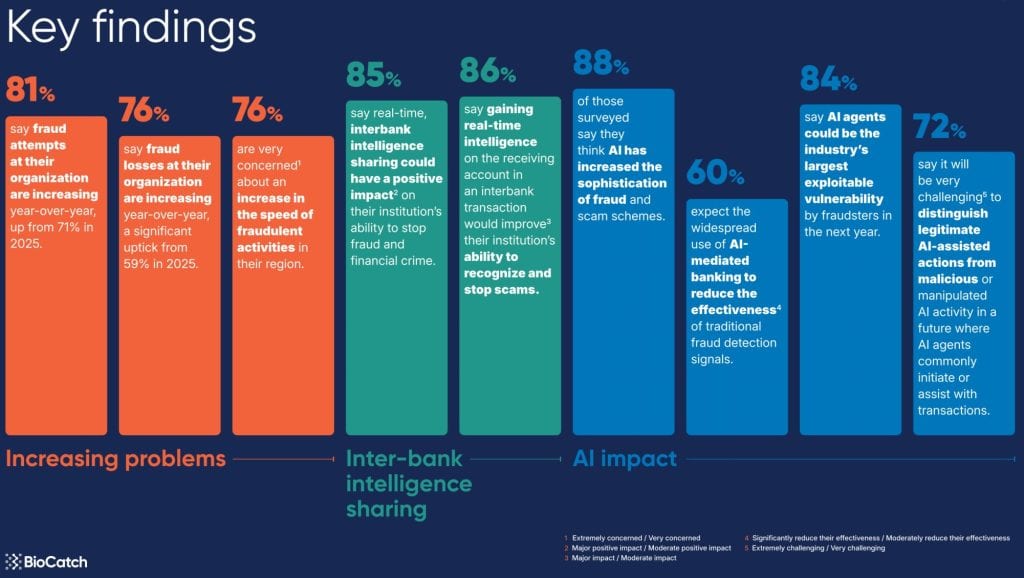
In Singapore, Indonesia, Thailand, India and Australia, concern is running higher than the global average. Eighty-six per cent of APAC respondents believe AI has increased the sophistication of fraud and scams—marginally above the 88% global figure.
Just as striking, 86% (against 84% globally) anticipate that AI agents could become the next major weakness for fraudsters within the next 12 months. Equally, 78% (compared with 72% globally) expect it will be very challenging to distinguish legitimate AI-assisted actions from malicious or manipulated activity, pointing to an escalating trust problem rather than a purely technical one.
The survey also reflects a clear deterioration in fraud outcomes and momentum. Eighty-one per cent of APAC leaders say fraud attempts at their institutions are increasing, while 78% report that fraud losses are rising. Speed is compounding the threat: 80% are very concerned about faster fraudulent activity, and 79% say their organisations have already encountered attacks using agentic AI.
BioCatch’s CEO, Gadi Mazor, cautioned that fraud prevention needs to evolve as digital interactions become more autonomous. “AI is starting to reshape how customers interact with e-commerce sites and financial institutions and will change how criminals execute fraud and other financial crimes,” he said.
“As digital interactions continue to grow faster, more automated, and increasingly driven by agents, we must move beyond static identity checks and toward a deeper and immediate understanding of behaviour, intent, and trust.” Gadi Mazor
The financial impact appears substantial. Almost half of APAC respondents (49%) report annual institutional fraud losses exceeding US$10 million, with 22% seeing losses above US$25 million. Customer losses also remain high, with 46% stating their customers lose more than US$10 million annually to authorised fraud and scams.
Beyond detection, the research flags commercial risk. Two-thirds (67%) of APAC leaders believe blanket friction in fraud controls has contributed to net customer loss—either via unreimbursed losses (53%) or excessive friction (46%).
At the same time, leaders show appetite for collective action: 93% believe interbank intelligence sharing would significantly improve the ability to stop fraud, and 92% say real-time insight on receiving accounts would make a meaningful difference.