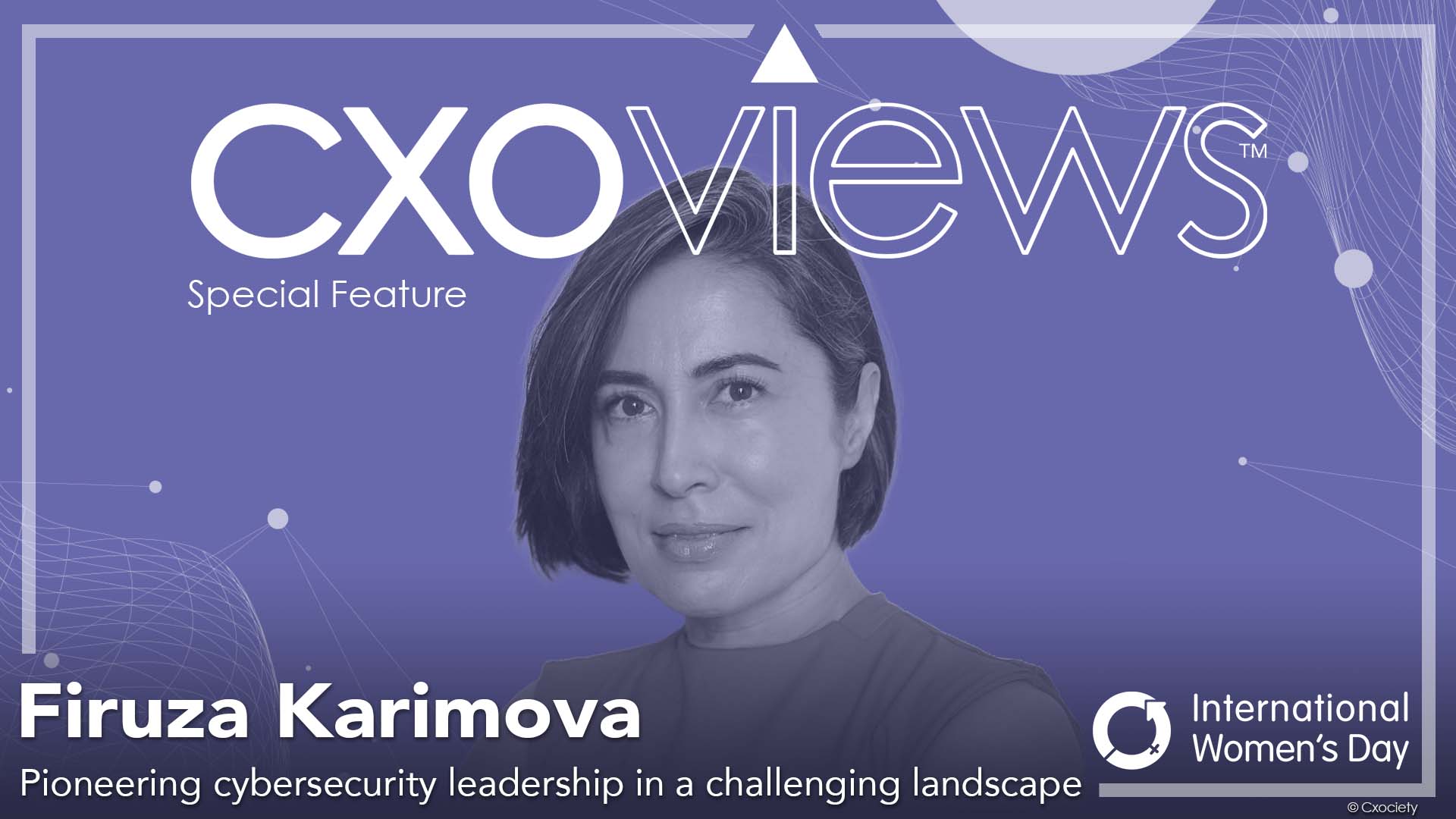
In an era when phishing emails and botnets were shifting from niche threats to global headlines, Firuza Karimova made a decisive move that would define her professional life.
She recalled 2007 as a turning point for her. At the time, the TJX Companies, an off-price retailer of apparel and home fashions in the US, experienced a breach that exposed 45 million customer records. This triggered a global rethink of data protection regulation.
In Northern Europe, Estonia was the target of a state-level Distributed Denial of Service (DDoS) attack, prompting the North Atlantic Treaty Organisation (NATO) to establish cyber defence entities.
“I was simply reacting to what I could see emerging around me,” she says. Working at a London-based consultancy, she volunteered to join the newly formed security function, becoming one of its first members. That early instinct to anticipate rather than react continues to shape her leadership philosophy today.
Now CISO for corporate & institutional banking (CIB), core technology and functions at Standard Chartered in Singapore, Karimova has spent nearly two decades turning foresight into resilience. Her career move from the UK capital to Asia was no accident; it aligned perfectly with her core values of clarity, recalibration and purposeful progression.
Navigating career pivots with purpose
Karimova views career milestones less as isolated “sliding door” moments and more as expressions of enduring principles. Relocating to Singapore and joining Standard Chartered were pivotal, yet she stresses that without a clear destination and constant recalibration, they might have been mere footnotes.

“You need to have clarity on your objective or destination, and you need to understand what the next step is towards that objective,” she explains. “You also need to be perpetually recalibrating, adjusting to your new horizons as you progress.”
This mindset has guided her from early risk and security roles into executive decision-making, where she now oversees cyber strategy across complex global operations.
At Standard Chartered, this proactive ethos mirrors the bank’s broader culture: anticipating risk, investing in resilience, and embedding responsibility into every function—from cybersecurity to people practices and governance. Inclusion, she notes, follows the same long-term logic rather than reactive fixes.
Shattering the glass ceiling: Comfort with challenge
An ISC2 study estimates that women still comprise under 20% of the cybersecurity workforce across Asia, yet Karimova refuses to see gender as an insurmountable barrier. “I believe in challenging,” she states plainly, “whether it be challenging decision makers, rationales or stereotypes.”
She draws parallels with the rapid growth of women’s participation in traditionally male-dominated sports such as football and rugby, driven by visible role models. The same momentum, she believes, is building in cyberspace.
“We are seeing an emerging cohort of female leaders, and I fully expect the coming years to see the sector experience an overdue gender correction.” Firuza Karimova
Standard Chartered’s own progress illustrates the point. Through targeted sponsorship, accountability and visibility, the bank has increased women’s representation in global senior leadership to over a third as of December 2025, with a clear upward trajectory.
Karimova’s own trajectory proves that comfort with challenge, combined with institutional support, can accelerate breakthroughs.
The power of exposure and sponsorship
Despite advances, gender prejudices persist, sometimes manifesting as women not being fully trusted as team members. Karimova has witnessed these attitudes diminish through simple exposure to high-performing female professionals. “Exposure takes down barriers in the same way that lack of exposure allows them to endure,” she observes.
“As more people in the workplace encounter strong, high-performing female working professionals, the need to identify and harness talent ultimately causes attitudes to change.” Firuza Karimova
Data from across the bank reinforces this: structured sponsorship and visible advocacy at mid-career stages—where attrition risk peaks—boost confidence and sustain ambition.
Mentoring, everyday inclusion and freedom from outdated notions of “female ambition” are, she argues, essential to encouraging women to take the next step. Her message is clear: sustained progress demands deliberate, ongoing effort rather than passive hope.
Embracing whole selves in cyber teams
Cybersecurity is frequently portrayed as a purely technical domain, yet Karimova insists it demands far more. “Perhaps more than other highly technical roles, (cybersecurity) demands smart leadership skills and soft skills in how we arrive at and implement decision making, aided by a willingness to collaborate and ability to focus on delivery and outcomes.”
Rather than redesigning roles, she opines that organisations should recognise candidates who excel both technically and in these broader leadership areas. “Organisations that value these broader skills tend to build more inclusive teams,” she adds.
“We see this reflected in engagement and inclusion metrics across Standard Chartered, where colleagues who feel recognised for both technical and leadership contribution report higher confidence, retention and performance.” Firuza Karimova
Creating cultures where women—and indeed all talent—can bring their whole selves is not idealism; it is smart business.
Diversity in perspectives to outsmart threats
As threats grow in sophistication and business impact, Karimova is unequivocal about the strategic value of diversity. “Each person’s professional, cultural and lived experiences shape our unique perspectives,” she explains.
Diverse teams generate richer problem-solving approaches, enabling organisations to anticipate, detect and respond more creatively than monolithic groups ever could.
This is no abstract ideal. Inclusive teams navigate complexity—whether cyber risk, regulatory shifts or market volatility—with greater agility.
In Asia’s fast-evolving threat landscape, gender diversity at the leadership table is therefore a practical advantage, not a compliance checkbox. Standard Chartered’s experience bears this out: broader perspectives deliver tangible gains in resilience.
The gift of trust
The 2026 IWD theme “Give to Gain” resonates deeply with Karimova’s own story. “It is simple – give trust and encouragement,” she says. Early in her career, colleagues and leaders trusted her potential and championed her growth. Peers generously shared knowledge during technical phases. That support proved instrumental in moving her from specialist roles into executive seats.
She pays this forward daily through formal mentoring and informal engagement.
“I strongly believe in paying forward in return and apply this in my approach, whether it is in formal mentoring or day-to-day engagement with the broader talent pool to achieve a common objective.” Firuza Karimova
For Karimova, “give to gain” is not rhetoric; it is a career-long operating principle that has enabled her to reach C-suite influence while helping others do the same.
Accelerating the next wave
Senior women in cybersecurity play a powerful role. However, Karimova cautions against supporting only those who mirror our own paths—a natural but limiting instinct. Instead, she urges proactive visibility, advocacy and learning from every colleague’s journey: “Observe how each person has taken the next step… and ask what can I learn from their path.”
Knowledge-sharing, sponsorship and everyday advocacy are practical ways to accelerate the next generation of female cyber leaders across Asia. By connecting talent with opportunity and championing diverse personas, senior women multiply their impact far beyond their own achievements.
Targets and accountability for 2030
If Karimova could suggest one concrete “Give to Gain” directive to boards, regulators and industry partners in Asia, it would be unequivocal: “Set a clear 2030 target and challenge others to do the same. Embed this thinking in your strategic planning, measure performance and be accountable.”
Standard Chartered exemplifies this approach. Gender equality is embedded at every level via the Global Diversity and Inclusion Council. Progress is tracked through the Inclusion Index, with a target of 35% women in global senior leadership by 2028 already within reach. Karimova is proud to have contributed to surpassing interim goals and remains optimistic about continued momentum.
Giving today for tomorrow’s gains
Karimova’s journey—from spotting cyber threats in 2007 to shaping strategy at one of Asia’s most respected financial institutions—embodies the “Give to Gain” spirit.
By building trust, challenging stereotypes, championing sponsorship, and demanding measurable targets, she has not only advanced her own career but also helped open doors for countless others.
In an industry still grappling with diversity shortfalls, her story offers both inspiration and a practical blueprint. As we mark International Women’s Day 2026, Karimova reminds us that true progress comes when leaders choose to give generously—of time, visibility, advocacy and accountability.
The gains, as her own remarkable trajectory proves, are profound, lasting and shared by entire organisations and the wider cybersecurity community.