


• About
  • Subscribe
  • Contact
Monday, March 2, 2026
  • Login
FutureCISO
  • People
  • Process
  • Technology
  • Resources
    • White Papers
    • PodChats
  • Events
No Result
View All Result
  • People
  • Process
  • Technology
  • Resources
    • White Papers
    • PodChats
  • Events
No Result
View All Result
FutureCISO
No Result
View All Result
Home FutureCISO Process Compliance and Governance

Open source vulnerabilities double due to AI’s rapid code creation

FutureCISO Editors by FutureCISO Editors
March 2, 2026
Open source vulnerabilities double due to AI’s rapid code creation

Photo by Christina Morillo: https://www.pexels.com/photo/close-up-photo-of-person-typing-on-laptop-1181675/

Share on FacebookShare on Twitter

The latest "Open Source Security and Risk Analysis" (OSSRA) report from Black Duck provides crucial insights into the dramatically changing landscape of open source software vulnerabilities, with significant implications for CISOs across Asia in 2026.
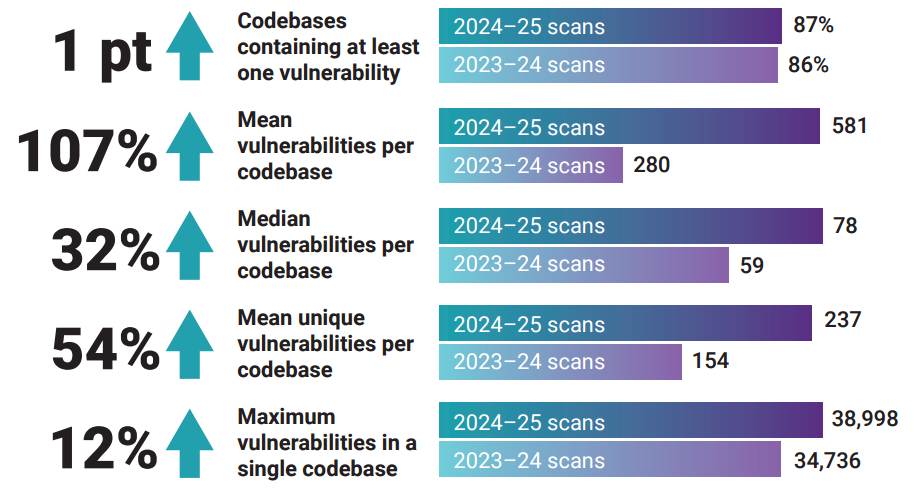
Vulnerability landscape: Key metrics and year-over-year changes
Source: Open Source Security and Risk Analysts report, Black Duck 2026

The report reveals a staggering 107% increase in the average number of vulnerabilities per codebase, as the proliferation of AI-assisted code creation accelerates the introduction of new risks.

With open source components now present in 98% of codebases globally, CISOs must grapple with the realities of third-party risks embedded within their applications.

The OSSRA report analysed nearly 950 codebases across 17 industries, highlighting that AI's integration into software development has not only inflated the volume of code but also exacerbated risk factors such as licensing conflicts and operational vulnerabilities.

The data indicates that 68% of audited codebases contain conflicts regarding open source licenses, marking the highest rate in the report's history. This represents a significant legal risk, putting additional pressure on security teams to ensure compliance amid evolving regulations, such as the EU Cyber Resilience Act. As many Asian enterprises embrace open source technologies, companies must monitor their software supply chains closely to navigate these complexities.

The report warns that governance structures have not kept pace with AI adoption; only 24% of organisations conduct comprehensive evaluations for AI-generated code regarding intellectual property (IP), licensing, security, and quality. This raises alarms for CISOs who must ensure robust governance frameworks to safeguard their organisations against potential legal repercussions.

The acceleration of code creation has also led to an increased attack surface that can be exploited by malicious actors. As AI tools proliferate, attackers are finding new pathways to inject vulnerabilities through third-party dependencies and unregulated AI-generated content.

"Every organisation is dependent on the security practices of open source maintainers, the licensing decisoons made for open source projects, and the continued viability of those projects' components." OSSRA 2026

For CISOs in Asia, this underscores the urgent need for enhanced visibility into their software environments to establish trust with stakeholders and comply with emerging regulations.

Related:  Strategic insights for securing Asia’s software supply chains

"Visibility has become the new currency of trust," says Jason Schmitt, CEO of Black Duck. He emphasises that understanding the full composition of software—not just openly licensed components—is essential for managing these risks effectively.

Tags: AI code risksBlack Duckopen source vulnerabilitiesOSSRAsoftware supply chain vulnerabilities
FutureCISO Editors

FutureCISO Editors

No Result
View All Result

Recent Posts

  • Open source vulnerabilities double due to AI’s rapid code creation
  • Identity is the frontline for Asia CISOs in 2026
  • Agentless visibility to facilitate breach containmet in hybrid environments
  • Advanced identity security solutions to combat cyber threats
  • Deepfakes move from novelty to enterprise risk in Asia 2026

Categories

  • AI and Machine Learning
  • Artificial Intelligence
  • Blogs
  • CISO
  • CISO strategies
  • Cloud, Platforms and Ecosystems
  • Cloud, Virtualization, Operating Environments and Middleware
  • Compliance and Governance
  • Compliance and Governance
  • Compliance and Governance|People
  • Compliance and Governance|Technology
  • Computer, Storage, Networks, Connectivity
  • Culture and Behaviour
  • Culture and Behaviour|People
  • Cyber risk management
  • Cyber risk management
  • Cyberattacks and data breaches
  • Cybersecurity careers
  • Cybersecurity careers
  • Cybersecurity operations
  • Cybersecurity operations
  • Data Protection
  • Data Protection
  • Endpoint Security
  • FutureCISO
  • Governance, Risk and Compliance
  • Governance, Standards and Regulations
  • Incident Response
  • Network Security
  • People
  • Process
  • Remote work
  • Resources
  • Risk Management
  • Risk Management
  • Security
  • Technology
  • Training and awarenes
  • Videos
  • Vulnerabilities and threats
  • Vulnerabilities and threats
  • Webcasts/Podcasts
  • Webinars and PodChats
  • White Papers

Strategic Insights for Chief Information Officers

FutureCISO serves the interests of the Chief Information Security Officer (CISO) and the information security profession. Its purpose is to provide relevant and timely industry insights around all things important to security professionals and organisations that recognize and value the importance of protecting the organisation’s data and its customers’ privacy.

Cxociety Media Brands

  • FutureIoT
  • FutureCFO
  • FutureCIO

Categories

  • Privacy Policy
  • Terms of Use
  • Cookie Policy

Copyright © 2024 Cxociety Pte Ltd | Designed by Pixl

Login to your account below

or

[wpli_login_link]

Not a member yet? Register here

Forgotten Password?

Fill the forms bellow to register

All fields are required. Log In

Retrieve your password

Please enter your username or email address to reset your password.

Log In
No Result
View All Result
  • People
  • Process
  • Technology
  • Resources
    • White Papers
    • PodChats
  • Events
  • Login

Copyright © 2024 Cxociety Pte Ltd | Designed by Pixl