





Asia-Pacific boards are entering 2027 with cybersecurity, data privacy and artificial intelligence at the top of their strategic agendas, even as many acknowledge that their capacity to oversee rapidly evolving risks has not kept pace.
New research from the Diligent Institute finds that managing cyber risk and protecting data and privacy is the leading board priority for the year ahead, cited by 69% of respondents, followed by AI deployment at 54% and operational cost optimisation at 52%.
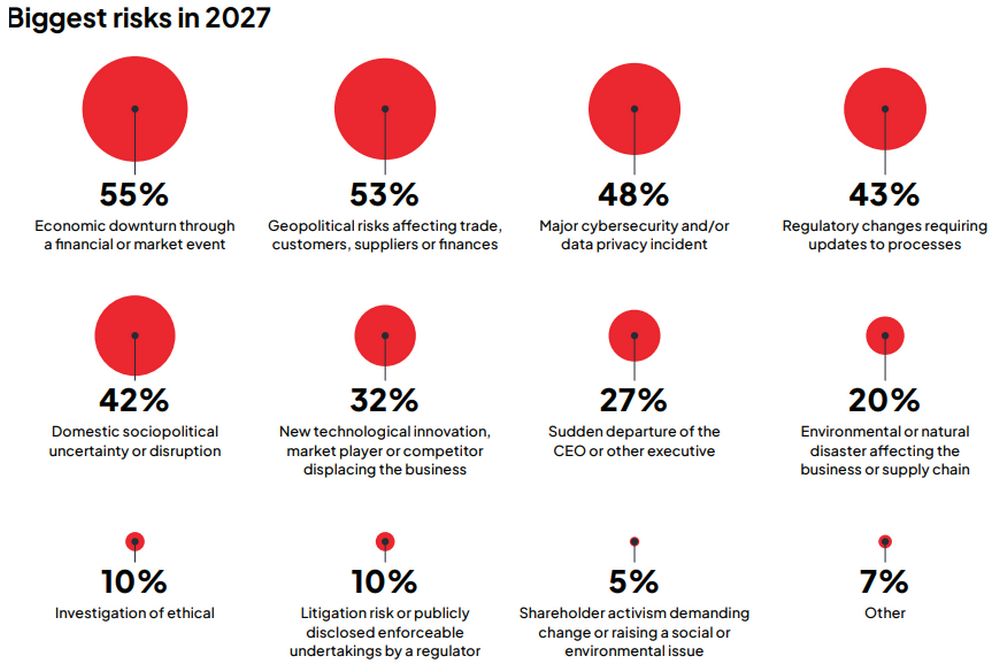
The findings, published in the APAC Governance Outlook 2027, suggest boards are attempting to pursue digital transformation and cost efficiency while confronting a volatile external environment.
Respondents identified economic downturns as the greatest anticipated source of disruption over the next 12 months, at 55%, followed by geopolitical events at 53% and cyber or data-privacy incidents at 48%.
Oversight gap
Despite the prominence of cyber and AI risks, only 15% of leaders said they were “very confident” that their board has the information, expertise and processes required to oversee significant risks. Insufficient time was the most commonly reported barrier, cited by 26% of respondents, while a lack of relevant expertise was cited by 17%.
The report also highlights a widening gap between AI adoption and governance readiness. Nearly one-third of respondents, 29%, said AI adoption is moving faster than governance, while 25% said governance is keeping pace and just 8% said governance is ahead of adoption.
AI is already entering boardroom workflows, but in uneven ways. The research found that 25% of respondents use approved AI tools, 17% reported informal use of general-purpose or consumer tools, and 25% have no foreseeable plans to use AI.
AI opportunity and concern
Boards see AI primarily as a tool for improving analysis and reporting, with 78% identifying improved data analysis and reporting as the leading opportunity. Workflow automation followed at 58%. However, security and privacy remain the principal concerns, cited by 66% of respondents, while half also raised hallucinations, misinformation or disinformation.
“Effective oversight is not about adding every emerging issue to an already full agenda. It’s about understanding how risks intersect, identifying what matters most to the organisation’s strategy and decisions, and ensuring management is taking action,” said Dottie Schindlinger, executive director of Diligent Institute.
Digital capability is emerging as the boardroom’s most pressing skills gap. Digital technology, including AI and data management, was the most frequently cited skills gap at 62% — more than twice the proportion citing cybersecurity, at 29%.

“Boards can start by asking for clear, integrated reporting that connects emerging risks to business priorities, dedicating time to challenging assumptions, and gaining a clear understanding of where and how AI is being deployed, including in their own governance processes.” Dottie Schindlinger
Boardroom capacity
The pressure on directors is reflected in their requests for structural change. More time for strategic planning or dedicated planning meetings was the most requested boardroom improvement, selected by 65% of respondents.
Nearly half, 49%, supported mandatory director training or continuing education, while 48% wanted greater access to external experts on specific risks.
The Diligent Institute’s report sets out four priorities for governance leaders: make time for strategy and emerging risks; connect risk reporting across the organisation; map how AI is being used; and align board expertise with the issues on the agenda.
The key takeaway for APAC boards is cyber resilience, AI governance and strategic capacity can no longer be treated as separate agendas.